What Happened to Birth? The Statistic That Sent Me Down a Rabbit Hole
By Alexia Leachman, founder of Fear Free Childbirth.
Alexia healed her own tokophobia and developed the method she used to do it – and has helped women clear theirs for over 10 years.
It landed on a dog walk.
In last week’s episode I was talking to Mars Lord about Black maternal mortality. The figure that usually gets quoted is a ratio, how many times higher the death rate is for Black women than for White women, and that ratio has improved. On the face of it you might think, oh, that’s all right then.
But Mars said something that didn’t land with me straight away: more or less, that it takes the situation getting worse for White women before anyone starts looking at what can be done for Black women. Later, out with the dog, I thought, hang on a minute, what did she say? It wouldn’t leave me alone. If the situation has got worse, what exactly has got worse?
I used to analyse data for a living, a long time ago, so I’ve got a bit of a data geek vibe going on. This episode is what I found down the rabbit hole of UK maternity statistics: mostly England’s figures, over the last ten years, about the environment women are giving birth in now.
One thing before we start. This is population-level data, so you can’t take any of it and say, that’s going to be my experience. If you’re reading this in a fearful or anxious state, it’s easy to jump to conclusions. These numbers describe a system. They don’t predict your birth.
Get the slides. Every chart from this episode, one data point per slide, with the source for each number so you can check it yourself. Free to download.
In this article:
The ratio that wouldn’t leave me alone
In England, in 2022 to 2024, the maternal mortality rate for Black women was 2.72 times the rate for White women. That’s down from a gap often quoted as around five. Back in 2012 to 2014 it was 4.2.
But a ratio compares two rates, and it can move because either one changes. It hides a multitude of sins. So I looked at the actual rates.
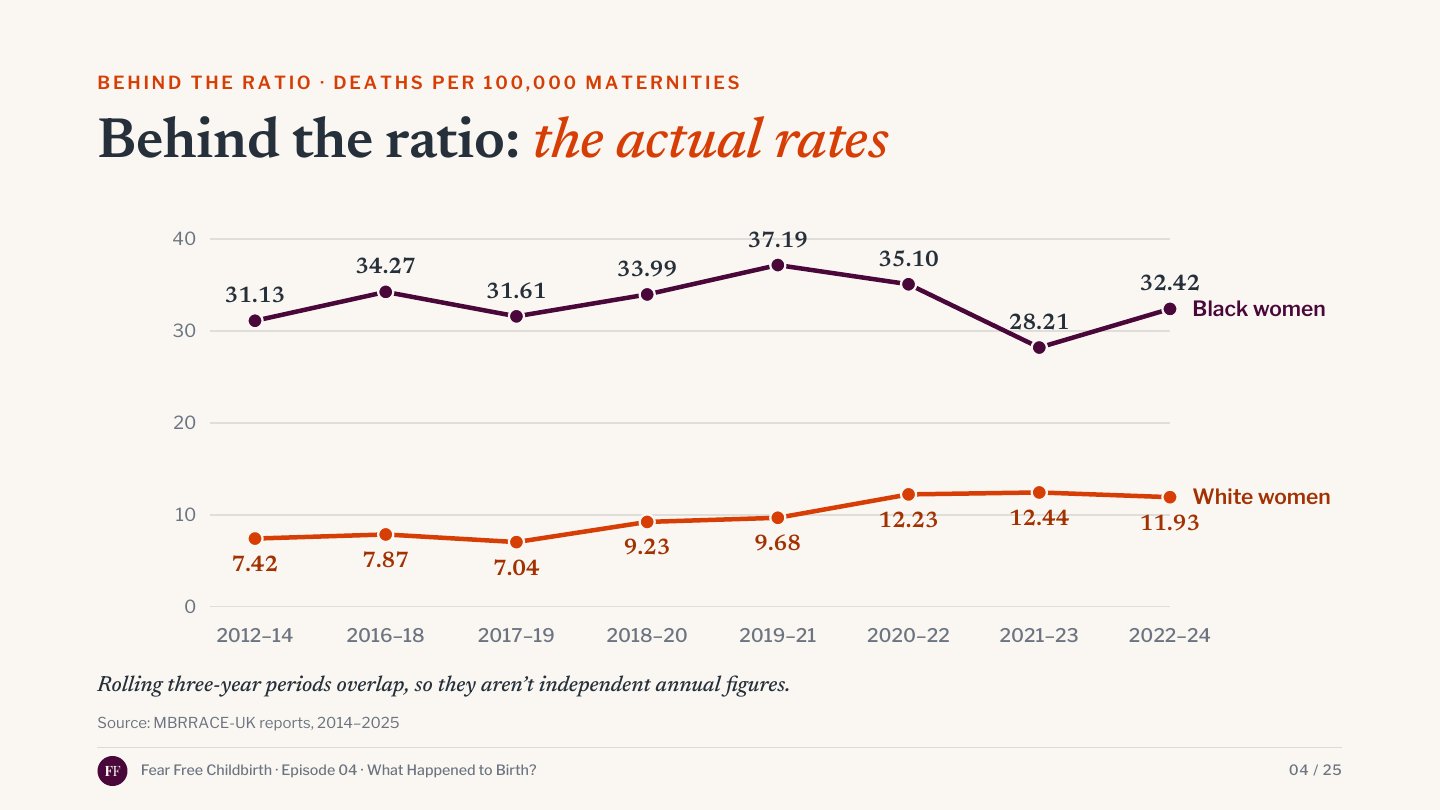
For White women the rate was 7.42 deaths per 100,000 maternities in 2012 to 2014. It climbed to 12.23 and is now 11.93. For Black women it has been far higher throughout, peaking at 37.19 in 2019 to 2021. It fell to 28.21 in 2021 to 2023, a real and encouraging fall, then rose again to 32.42.
This is what Mars was pointing at. Between 2019 to 2021 and 2020 to 2022, the ratio fell from 3.84 to 2.87. But the rate for Black women only moved from 37.19 to 35.10, while the rate for White women rose from 9.68 to 12.23. MBRRACE-UK, who publish these figures, cautioned that the apparent reduction in the disparity largely reflected more White women dying.
Maternal death in England remains rare. But something had shifted, and I wanted to know what else had.
What happened to women’s mental health
What I’m really interested in is women’s mental health, because how a woman feels after one birth shapes how she feels about the next, if she decides to have one at all.
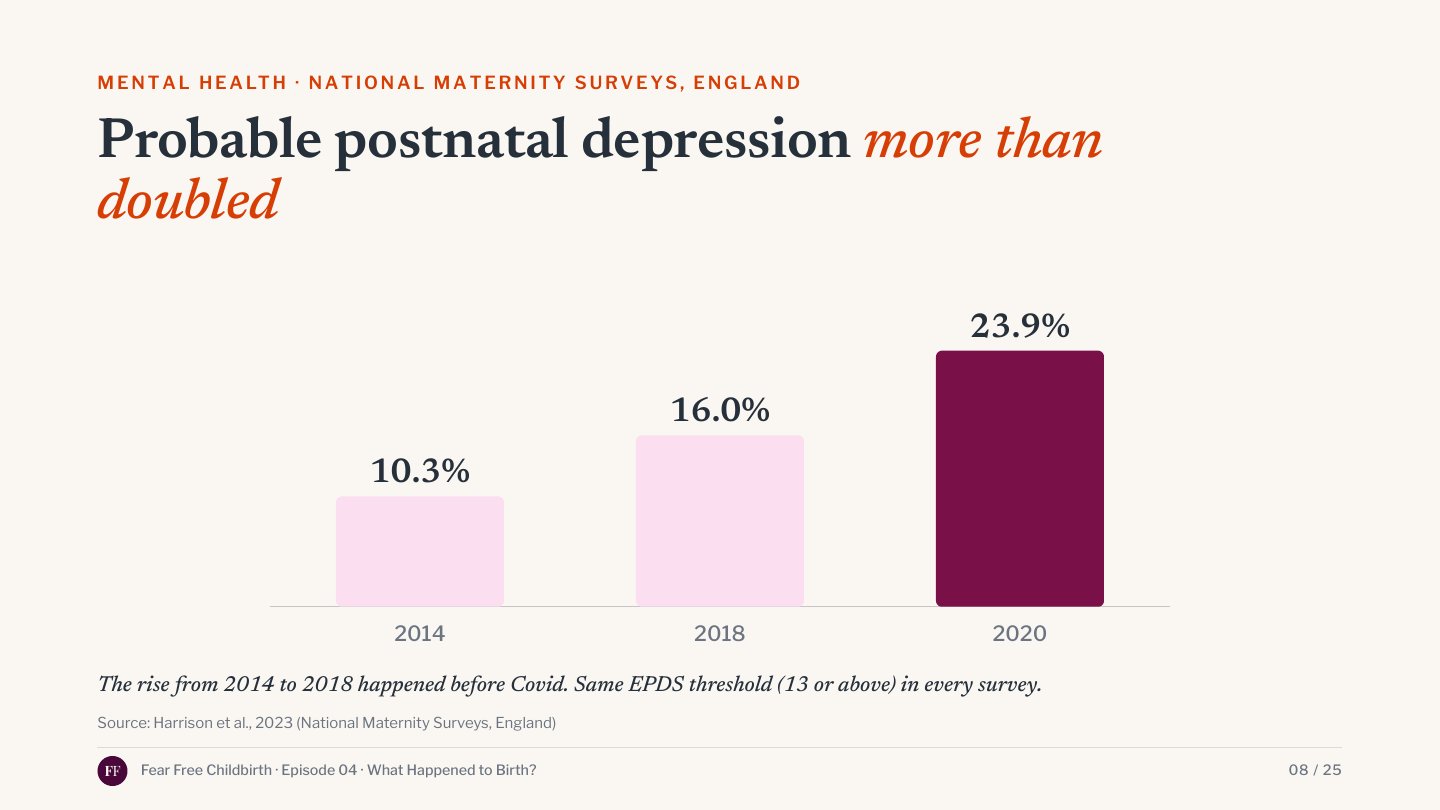
In 2014, 10.3% of women in the national maternity surveys had probable postnatal depression. By 2020 it was 23.9%. More than doubled, and the rise from 2014 to 2018 happened before Covid.
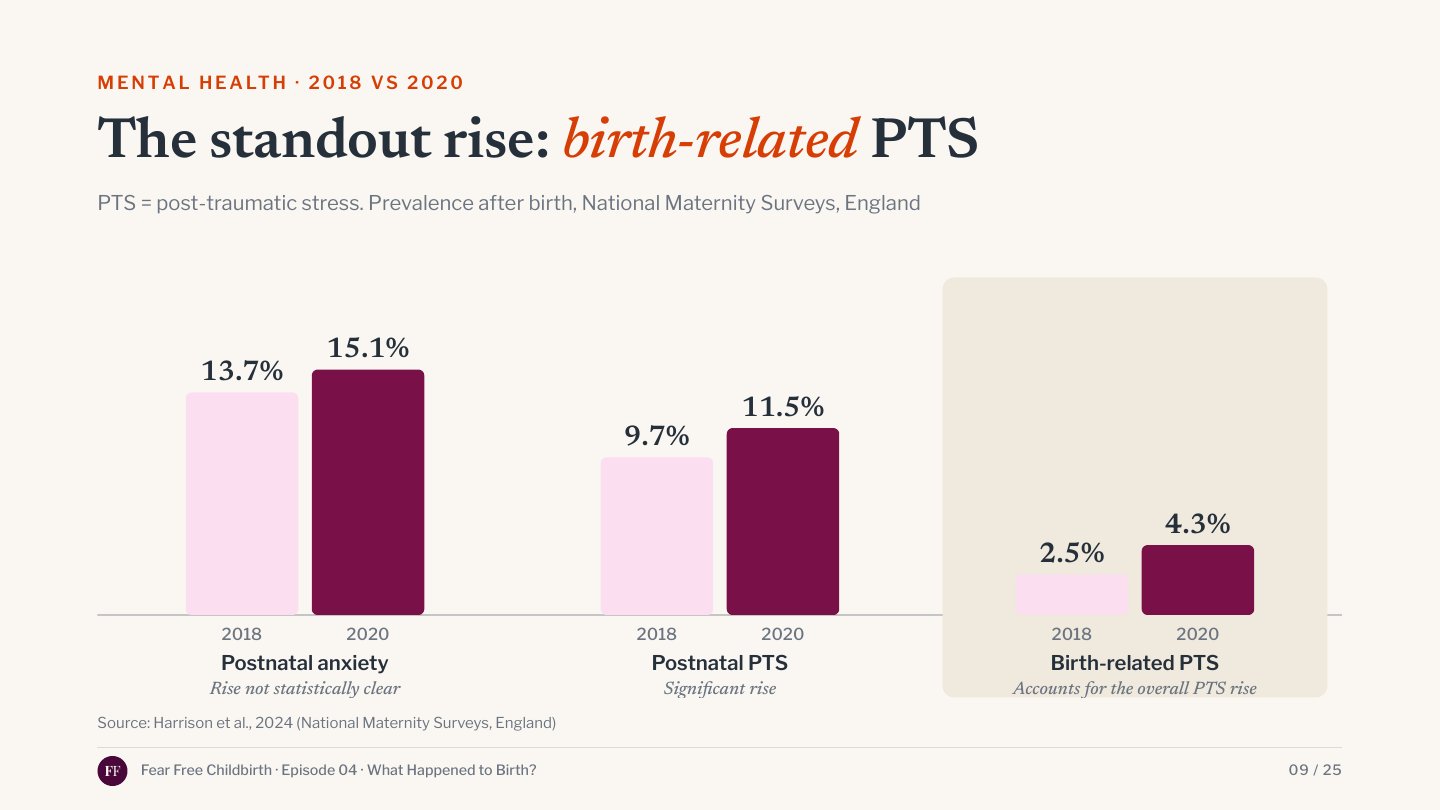
Between 2018 and 2020, postnatal post-traumatic stress went from 9.7% to 11.5%. Birth-related post-traumatic stress went from 2.5% to 4.3%, and that accounts for the overall rise.
The newest National Maternity Survey, of women who gave birth in 2024, found that 1 in 10 had symptoms of post-traumatic stress six months after the birth, higher than in any previous survey. Three in 10 had symptoms of depression, anxiety or post-traumatic stress.
Before, during and after birth are all one thing for a woman. Antenatal anxiety was associated with a greater risk of postnatal depression, anxiety and post-traumatic stress later on. Higher satisfaction with the birth, and stronger social support, were protective.
What about tokophobia? There’s no clean trend line to show you. Studies use different definitions for fear of childbirth, severe fear and diagnosable tokophobia, and I didn’t want to shoehorn in data for the sake of a nice-looking slide. But fear isn’t a side issue in birth. It can decide whether a woman has babies at all, or a second one.
What women are saying about their care
In 2019, 72% of women told the CQC maternity survey they were always able to get help from staff when they needed it during labour and birth. By 2024 it was 64%.
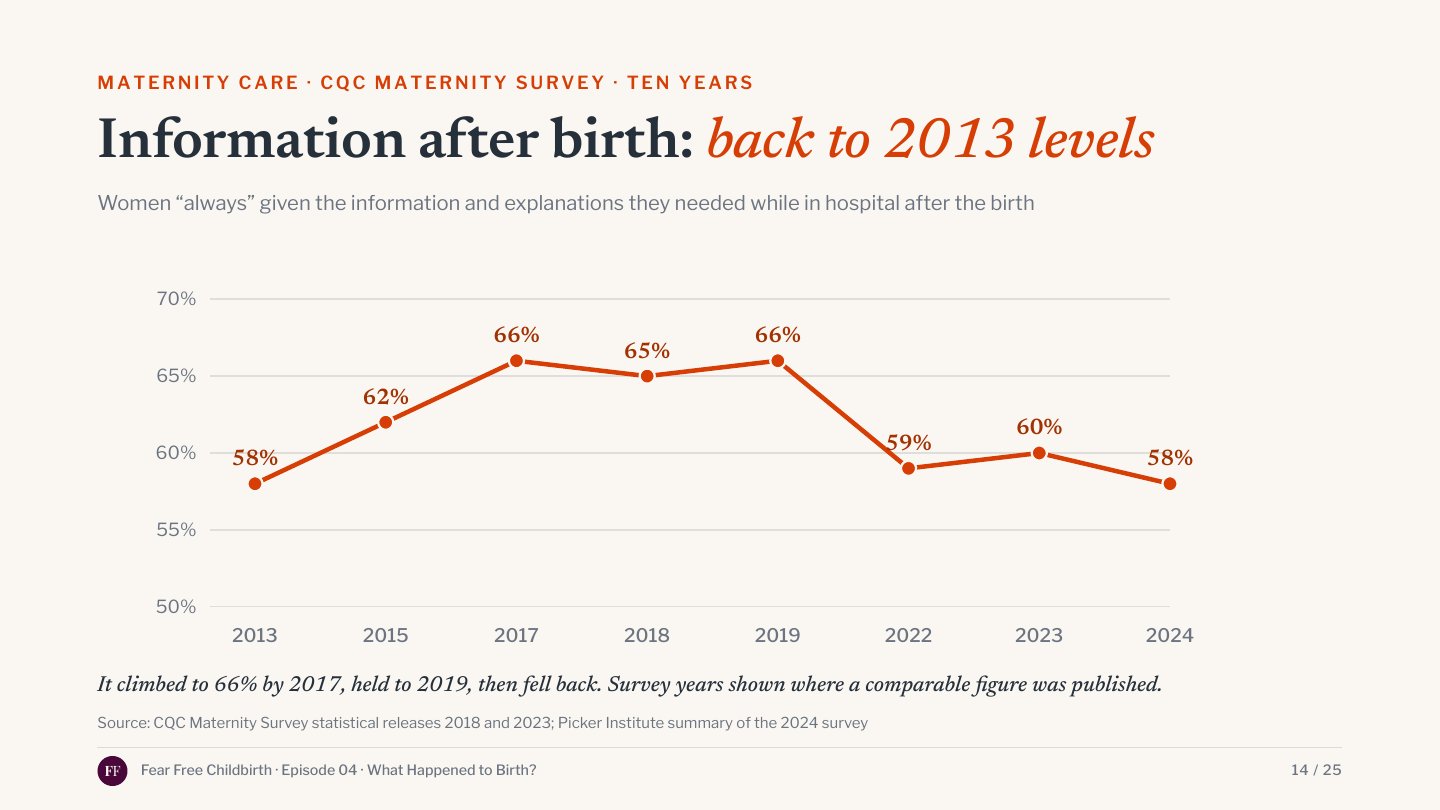
The one I want us to dwell on is information. In 2013, 58% of women said they were always given the information and explanations they needed in hospital after the birth. That climbed to 66% by 2017 and held there to 2019. By 2024 it was back at 58%.
So 42% of women weren’t always getting the information they needed. What does that mean for informed consent? I find that troubling.
In 2022, 19% of women weren’t offered any choice at all about where to have their baby.
I chose to birth my second daughter at home in 2016, and I was able to honour that choice. That year 2.1% of maternities in England were at home; by 2022 it was 1.9%, after a brief rise during the pandemic. Tiny numbers. What I care about more than the percentage is whether women are offered a meaningful choice.
What happened to birth itself
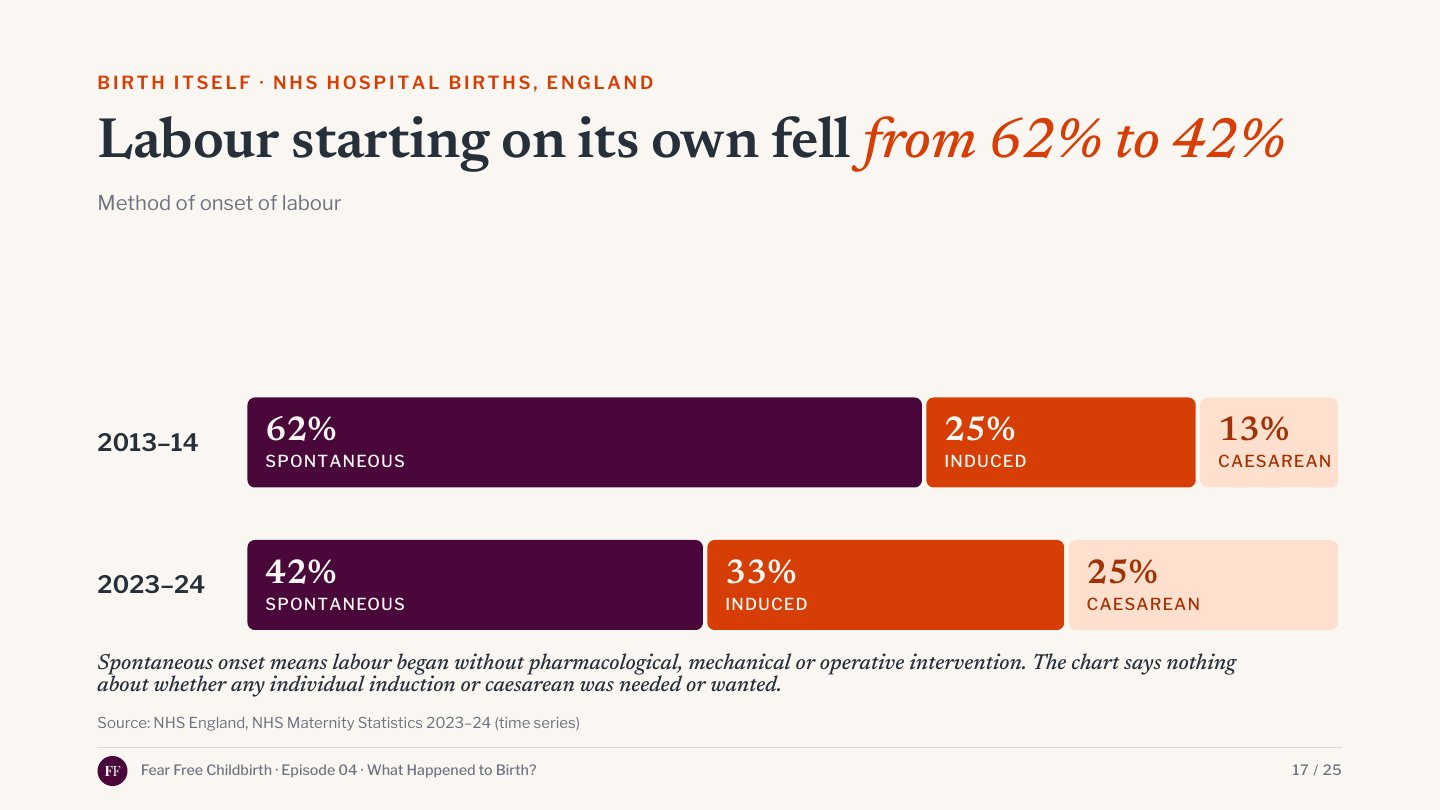
In 2013 to 2014, labour started on its own in 62% of NHS hospital births in England. By 2023 to 2024 that was 42%. Induction went from 25% to 33%, and births where the onset was a caesarean went from 13% to 25%.
That chart says nothing about whether any individual induction or caesarean was needed or wanted. If you choose an induction or a C-section, that’s absolutely okay, and it isn’t a failure on your part. What it does tell us is that women now face a lot more decisions that can shape their birth, and, as we’ve seen, may not get the information in the moment.
What the UK maternity statistics can’t tell you
The slide pack has a page on what these numbers don’t show:
- that anxiety causes maternal death
- that intervention caused the rise in maternal mortality
- that hospital birth is inherently unsafe, or home birth inherently safe
- that the whole shift from around five times to 2.7 times is an illusion (there was a real fall in 2021 to 2023)
- that England’s trends apply automatically to every other country
- that women with poor outcomes failed to advocate for themselves
On that last one: you’re not responsible for negligent care or a bad outcome. But nobody will ever have as much invested in your pregnancy and birth as you do, and you have the right to take part in the decisions about your body and your baby.
Knowledge, capacity and the questions to have ready
Agency starts with knowledge: knowing your options and the risks, and having it worked out before the day. I always encourage women to write more than one birth plan, one for the birth you want and one for the birth you don’t, so you’ve already thought through the decisions you might face.
Then there’s psychological capacity, being able to use those options when you’re frightened, tired or vulnerable. You might think you’ll decide on the day. Not if you haven’t slept for 24 hours and haven’t eaten for 12.
Put those together and you can stay an active participant in your own care, even if the birth doesn’t go the way you wanted. If it becomes a C-section you didn’t want, you can still make choices about how it unfolds. If you didn’t feel informed, if you felt forced into something, that’s the thing that’s going to eat you up later.
Not sure where your fear sits?
The free Tokophobia Test takes about five minutes and gives you a picture of what you’re dealing with, whether or not you’re pregnant now.
Take the free Tokophobia Test › (Provided by our partner Fearless Birthing.)
Questions worth having ready
These are for working things out together with your midwife or doctor:
- Why are you recommending this?
- What are my alternatives?
- What’s the absolute risk, not just the relative risk? “Twice as likely” might mean going from 1.2% to 2.4%.
- What happens if we wait?
- Is this hospital policy or a clinical necessity?
- What evidence is this recommendation based on? I used this one in my own birth. The staff couldn’t share any evidence for what they were recommending, which made my decision much easier.
- Do we have time for me to think or talk this through?
- I understand the recommendation. I do, or I do not, consent.
It’s all very well saying, just ask for the evidence, just say you don’t consent. Not everybody has that in them. Maybe you have a fear of authority: they’re the expert, and who are you? You just turned up here. Maybe you’re frightened of being difficult, especially if you’ve got a people-pleaser streak. Or the freeze response stops you speaking up at all.
This is where fear clearance work comes in: prising open your fears and picking them off one by one. It doesn’t guarantee a perfect birth. It gives you more chance of staying present enough to think things through and stand up for yourself.
Mars and I agreed that the system needs to change, and that will take a while. My voice isn’t going to get maternity policy changed. But when more and more women expect explanations, real consent, real options and respectful involvement, that gathers momentum from the bottom up. Wouldn’t that be brilliant?
We can’t control birth, or every clinician we meet. You can control how you meet those things, which makes birth preparation more important now than it has ever been. And if your fear is high, or you have tokophobia, the first job may be reducing the fear enough that you can engage with the information at all.
Next week I keep pulling the thread: what happened to having babies.
Questions I get asked about this
Is maternal mortality in the UK getting worse?
In England, the maternal mortality rate for White women rose from 7.42 to 11.93 per 100,000 maternities between 2012-14 and 2022-24, and the rate for Black women is higher now than it was ten years ago. Maternal death remains rare, and these are population rates, not a prediction for any one woman.
Why has the gap between Black and White maternal mortality narrowed?
For part of the period, mainly because more White women died. Between 2019-21 and 2020-22 the ratio fell from 3.84 to 2.87, while the rate for White women rose from 9.68 to 12.23. There was a real fall in Black maternal mortality in 2021-23, but by 2022-24 it had risen again.
Are more women being induced than ten years ago?
Yes. In NHS hospital births in England, induction rose from 25% in 2013-14 to 33% in 2023-24, and labour starting on its own fell from 62% to 42%. The figures don’t say whether any individual induction was needed or wanted.
What questions should I ask if I’m offered an intervention?
Why is this being recommended, what are my alternatives, what is the absolute risk, what happens if we wait, is this policy or clinical necessity, and what evidence is it based on. You can always say you understand the recommendation and that you do, or do not, consent.
Where to go from here
If any of these numbers sat heavily with you, go back to where we started: they describe a system, and you still have the right to take part in every decision about your own birth.
Understanding where your fear sits is a good first step. The free Tokophobia Test takes about five minutes and tells you what you’re facing – no pressure, no scare tactics.
When you’re ready to stop carrying this on your own, the Tokophobia Support Circle is a small monthly membership where women who understand make sense of it together, with a live group call each month. For focused one-to-one help, there’s the Tokophobia Support Programme.
Both are run by our partner site Fearless Birthing – founded, like Fear Free Childbirth, by Alexia Leachman. You can also read Alexia’s books, Betrayed By Your Biology and Fearless Birthing.
And if you haven’t heard Mars before, her earlier episode on ethnicity scans and Black-bodied maternal health is a good place to start.
About the author: Alexia Leachman overcame her own tokophobia – and in the process developed the Head Trash Clearance Method, the approach she now uses to help women clear their fear of pregnancy and birth. For over a decade she has worked with women around the world and trained perinatal professionals to do the same. She is the author of Betrayed By Your Biology, a book on tokophobia and reproductive anxiety, host of the Fear Free Childbirth podcast, and is often described – by the women she works with and by the podcasts that invite her on – as a world expert on tokophobia. More about Alexia ›
Fear Free Childbirth is a publication and is not a substitute for medical or mental-health care. If you’re struggling to cope or in crisis, please contact your GP, midwife, or a qualified professional.
Read next:
- 16.5% of women fear birth enough for it to shape their lives: the numbers
- Essential steps of birth preparation
- Induction and the pressure to induce, with Patti Good

- Thousands of Mothers May Be Living With Undiagnosed PTSD After Childbirth - 16th October 2026
- What Happened to Birth? The Statistic That Sent Me Down a Rabbit Hole - 16th October 2026
- Induction and Birth Trauma: What a New Study Found - 12th October 2026