What Happened to Having Babies? Fertility, Fear and the Rabbit Hole
By Alexia Leachman, founder of Fear Free Childbirth.
Alexia cleared her own tokophobia and developed a method that has helped women clear theirs for more than 10 years.
While I’ve been talking about fear of birth for the last 10 years, something else has been going on in the background. We’ve been making fewer babies. I was researching the last episode, going right down into the data on birth itself, when I realised there was a much bigger piece going on in parallel: the falling fertility rate.
When I first started this podcast, it was all about what a woman could do to help herself have a fear-free childbirth. What’s increasingly obvious to me is that it’s so much bigger than the woman. It’s the system, and it’s societal and cultural too. So this one is about fertility. And somewhere in the middle of the research I hit a number that stopped me in my tracks.
Get the slide pack
Every slide from this episode, with the source for every number. Free to download.
In this article:
What the falling fertility rate looks like
In England and Wales, the fertility rate has dropped from 1.82 in 2015, the year Fear Free Childbirth began, to 1.39 in 2025. That’s a fall of around 24% in 10 years. That’s massive, right? The replacement rate is around 2.1, so we were already below it. The gap has just got wider.
There was a little bump in 2021, then the decline carried on. In 2025, 585,396 live births were registered, against 697,852 in 2015. That’s 112,456 fewer babies. That’s a lot of babies.
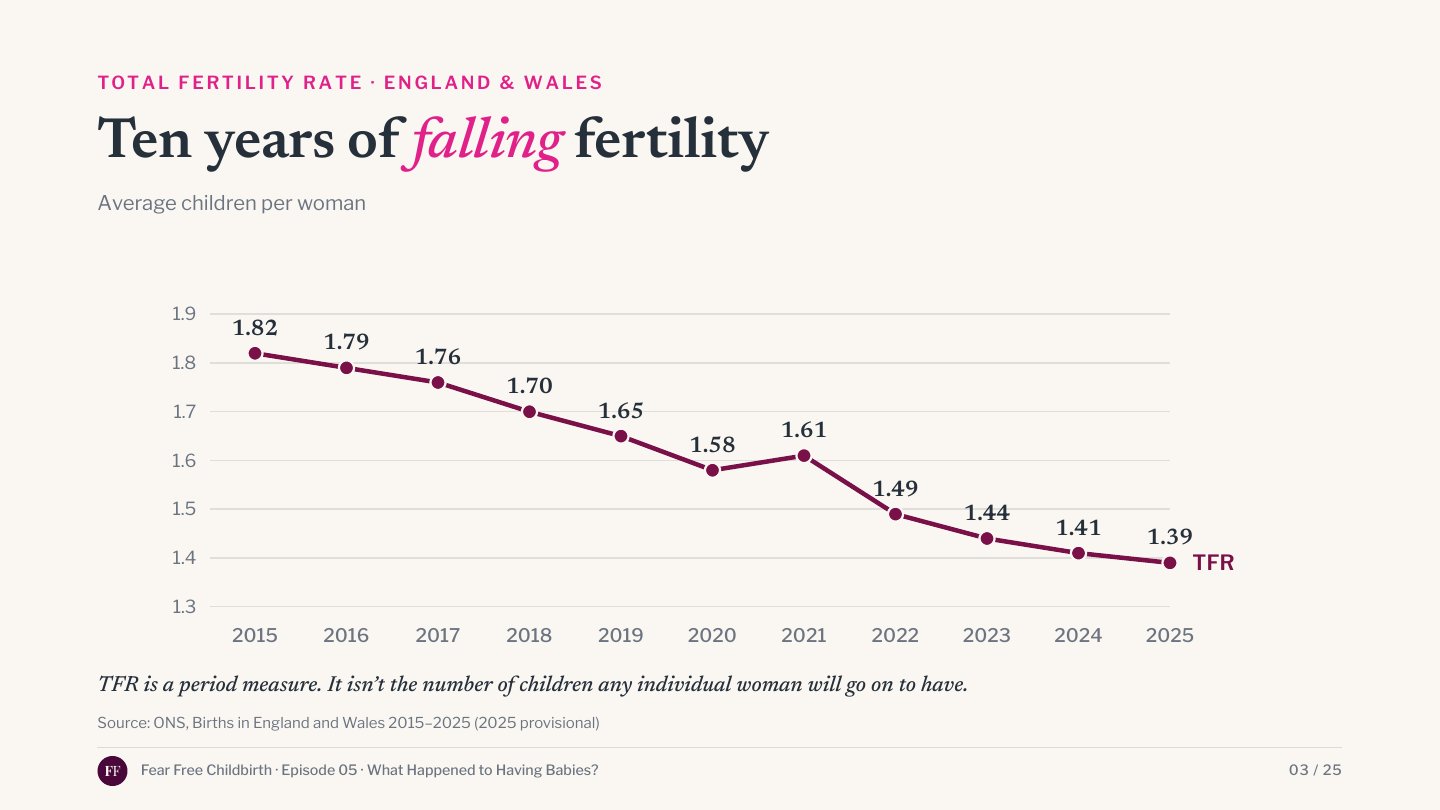
One caveat from the slide: the total fertility rate is a period measure. It isn’t the number of children any individual woman will go on to have.
It isn’t just us. France has gone from 2.00 to 1.61, the United States from 1.84 to 1.60, Finland from 1.71 to 1.25, and South Korea, bless them, from 1.24 to 0.75. Worldwide the rate has gone from 3.31 in 1990 to 2.25 now, only just above replacement, though that average hides a lot: many countries are now well below it, and others, mostly in sub-Saharan Africa, are still well above.
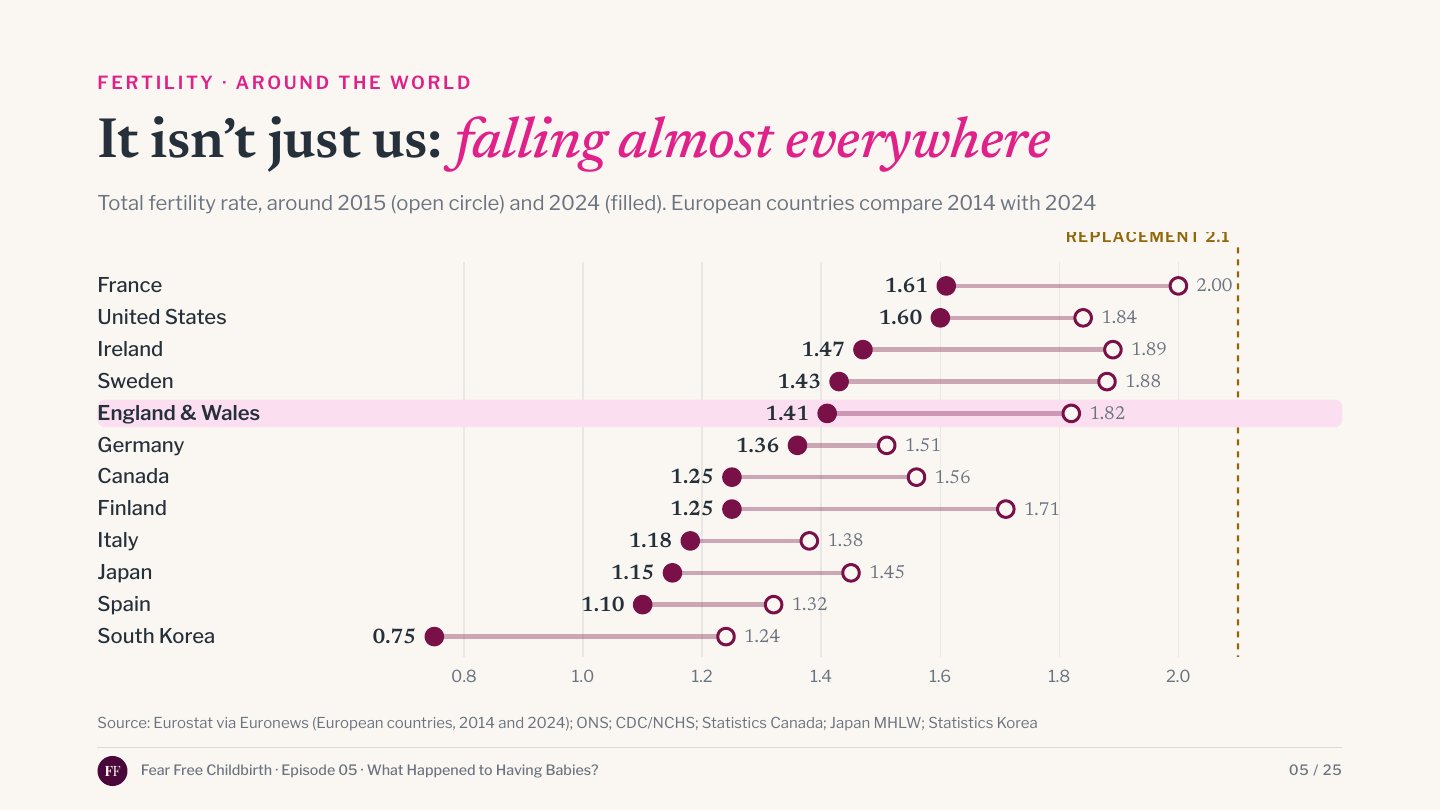
In 2025 the United Nations Population Fund (UNFPA) ran a survey across 14 countries, and one in five people expected not to have the number of children they wanted. More than half of them cited economic issues as a barrier. Others named housing, job insecurity (with AI right now, that’s no big surprise), concern about the future, no suitable partner, and unequal caregiving.
The question I’m left with is what’s getting in the way between people and the families they want. Wanted family size can be higher or lower than the family you’ve got. Having reproductive agency means being able to choose that freely. Birth-rate targets don’t come into it.
Where is fear on the list?
Looking at all those reasons, there seemed to me to be a massive gap. Where is the woman who says, I do want the baby, we desperately want a baby, but I’m just terrified of what I have to go through in order to get one? The pregnancy, the birth, the pain, getting injured, the maternity system, mortality, interventions, losing control. Any one of those is a valid reason for a woman not to have a baby, and none of them seemed to be on the list I was looking at.
Was it even asked? Because if a survey doesn’t offer that as a reason, where are those women in the data?
Then I found women who had been asked. A small study in Sweden in 2022, by Rondung, Magnusson and Ternström, deliberately recruited nine women who weren’t pregnant, had never given birth, wanted children, and were hesitant to become pregnant because of their fear of childbirth.
Yes, it’s small. What I care about is that these women demonstrably exist. I could have told you that, because I work with these women all the time, but it’s important they’re captured in the research.
They absolutely did want children. Desire and fear were in direct conflict. It’s something I see a lot: women who desperately want to be mothers and also desperately don’t want to be pregnant. How do you reconcile those two things? They described actively avoiding pregnancy, and struggling to separate what they wanted from what the fear was making them do. Some believed they would already have started a family if it hadn’t been for the fear.
And most fear-of-childbirth support is organised around women who are already pregnant, which is the very thing these women are afraid of. This is a major, major issue.
When we ask people about their fertility intentions, would we know the difference between a woman who doesn’t want children and a woman like this? These women are saying, I want children, but I can’t. And the can’t is about how they feel.
Wondering whether fear is part of this for you?
The free Tokophobia Test takes about five minutes and gives you a picture of what you’re facing. It works whether or not you’re pregnant, and whether or not you intend to be.
Take the free Tokophobia Test › (Provided by our partner Fearless Birthing.)
And then I hit 27%
In Finland there’s a survey called the Family Barometer. In 2022, 27% of mothers with one child said fear of childbirth or their previous birth experience had delayed trying for another child they still wanted. (I found it cited in a 2025 paper by Silvan and colleagues.)
Twenty-seven per cent.
The main challenge is the question itself. It combines fear of childbirth with previous birth experience, so we can’t separate the two. And we can’t say that 27% of these mothers have tokophobia, which is a severe fear and a different thing from ordinary nerves about birth. What it does is link fear, or a difficult previous birth, directly with women delaying a child they still want.
That sent me down another rabbit hole.
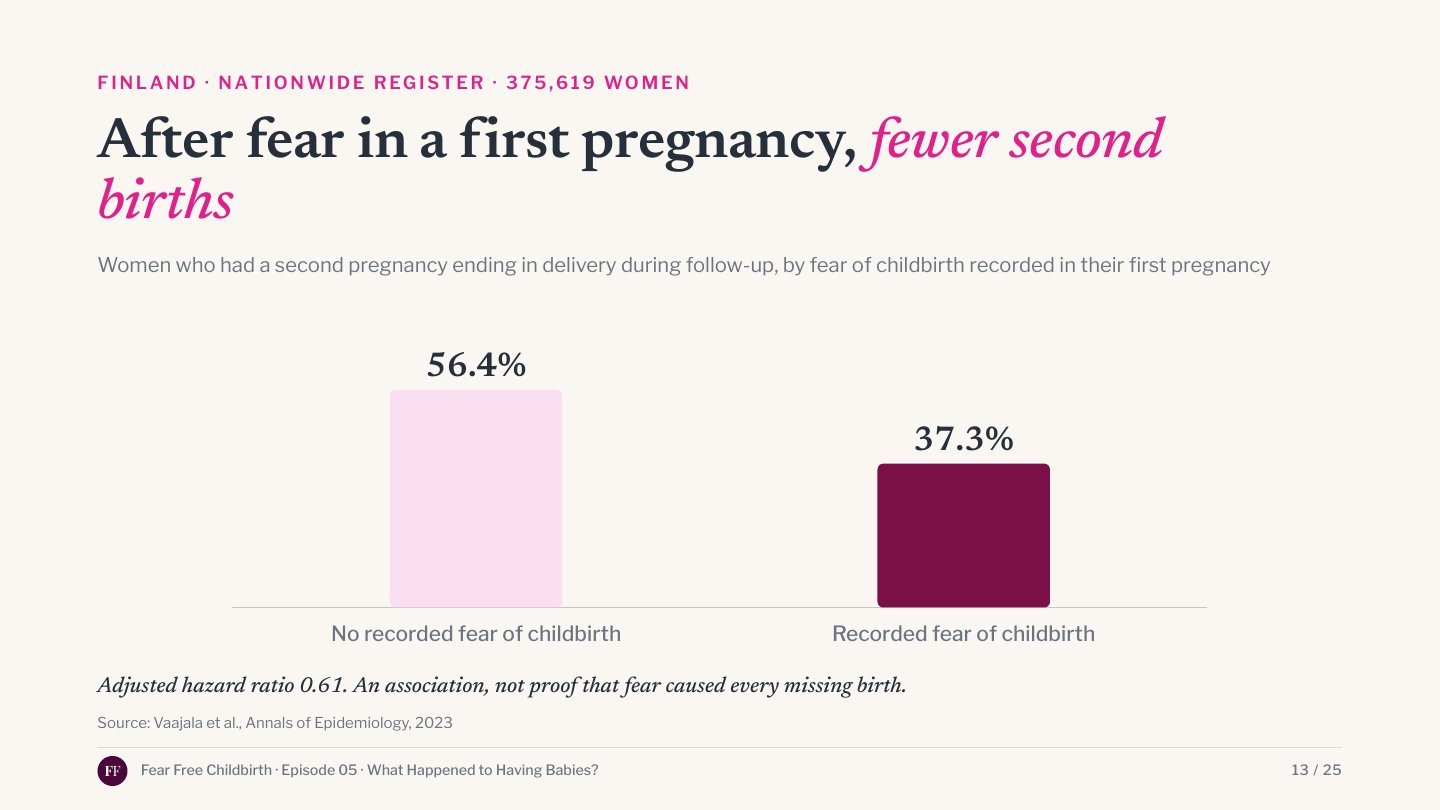
That a difficult first birth could affect your decision about a second makes a lot of sense. A Finnish register study of 375,619 women (Vaajala and colleagues, 2023) found that among women with fear of childbirth recorded in their first pregnancy, 37.3% went on to a second pregnancy ending in a birth during follow-up. Among women without, 56.4% did.
Another Finnish study, of 45,947 first-time mothers (Joensuu and colleagues, 2023), found the median wait for the next baby was 3.90 years after a positive first birth experience and 5.29 years after a negative one. A negative first birth was also linked with a 19% lower adjusted likelihood of another birth.
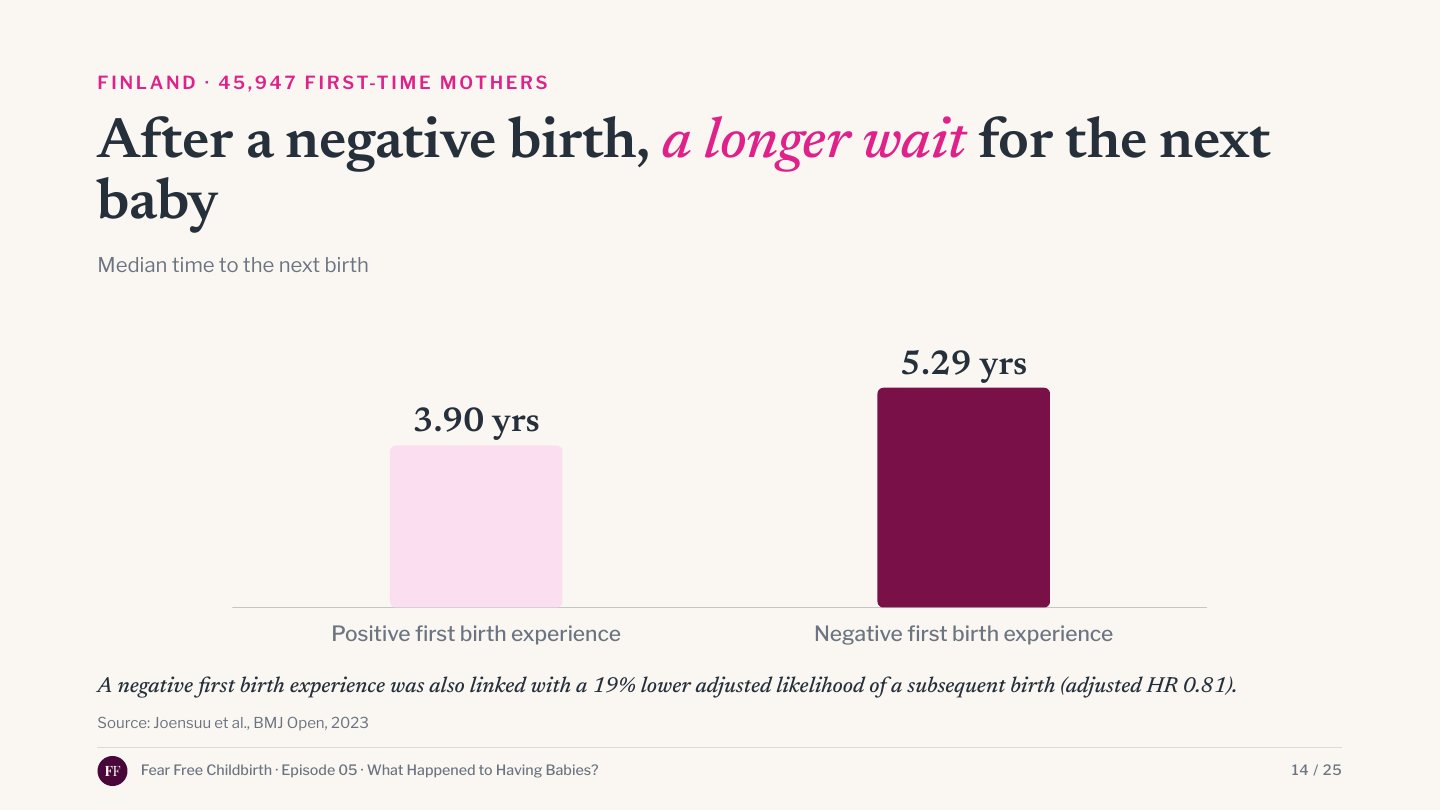
These are associations. We can’t say that fear or a negative birth is responsible for the missing second baby in a family. That’s going too far. But it’s very clear that the birth experience doesn’t end when the baby is born. It reaches much further into the future, into whether there might be another baby.
I hear these stories all the time, but anecdotes aren’t enough to change policy, are they? If you’ve had a difficult first birth yourself, Heather’s story is one woman’s route from a traumatic first birth to a positive one.
Fear of becoming a mother
It isn’t always fear of birth. One of the other reasons is becoming a mother. What will motherhood do to me, to my life, to my identity?
I’m seeing a lot more women come through my work with exactly these questions. Some of them feel they’re going to suddenly take on a new identity they haven’t chosen, that society has put on them, and they’ve just got to roll with it. And they don’t want to roll with it.
Can I afford the version of motherhood I see all around me on Instagram? Am I going to be taken seriously at work? What about my income, my independence? There’s more on the plan society has for you the moment you become a mother.
In the UK, statutory maternity pay for 2026/27 is £194.32 a week after the first six weeks (or 90% of earnings if that’s lower). That will barely pay for nappies, right? Then add anxiety on top, because anxiety doesn’t give you a clear mind. It just makes everything feel harder.
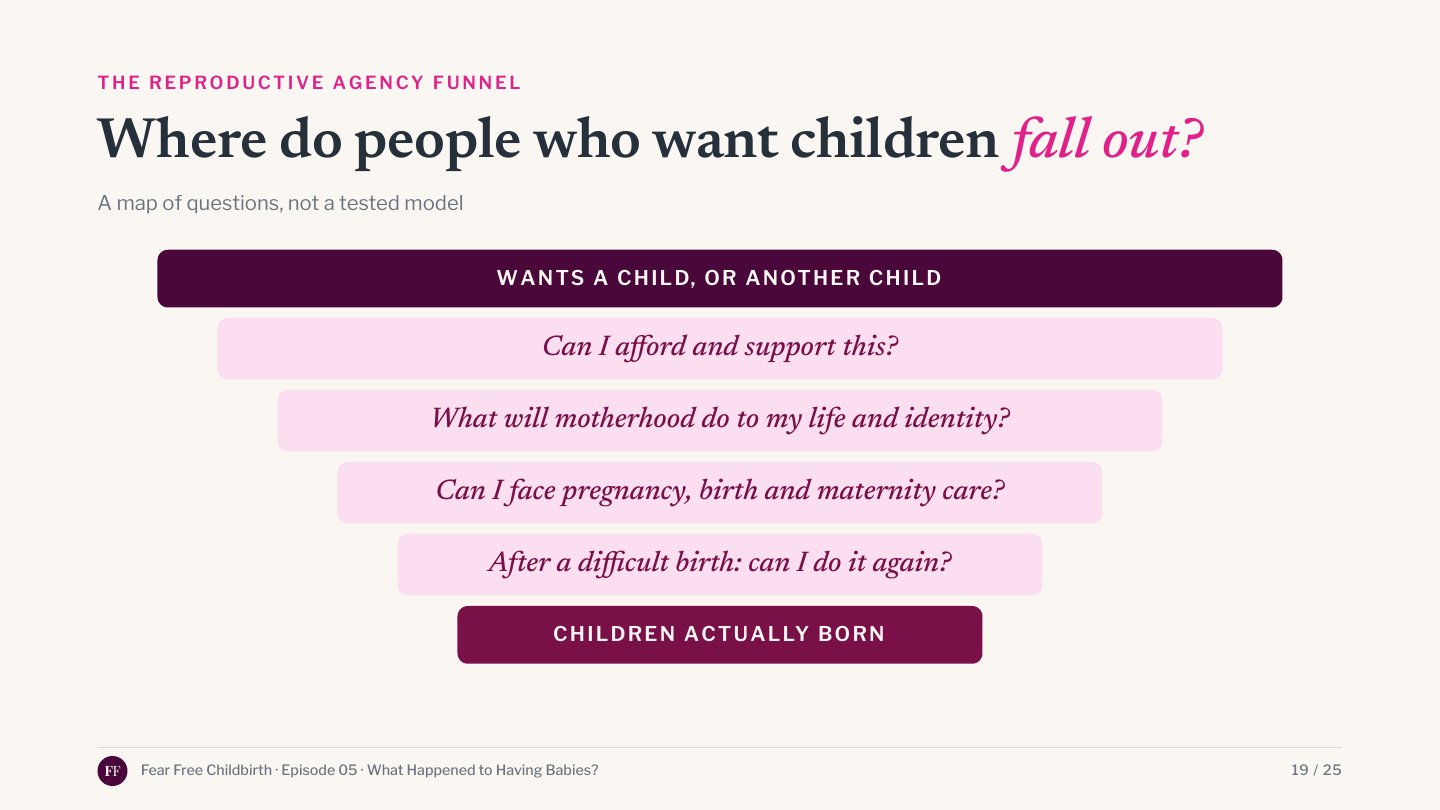
“Do I want a child?” and “Does motherhood feel possible?” are different questions. Laid out as what I’ve called a reproductive agency funnel (a map of questions, nothing more), they act almost like gates. Not every woman gets through every gate.
Down the rabbit hole
So the evidence does link fear and difficult births with fewer or later babies. What we can’t say is that tokophobia caused the fall in fertility. Absolutely not. Or that every woman who stops at one child secretly wants another. We’re definitely not saying falling fertility is bad, or that women owe society babies. And psychological preparation can’t make up for unsafe, disrespectful or poor maternity care.
When I started researching this episode, I wondered whether fear might be one of the things hiding in that gap between the children women want and the children they eventually have. It turns out I’m not the first person to ask. But we still don’t know how many wanted babies aren’t being born because fear changes the decision. Most fertility research doesn’t separate out fear of pregnancy and childbirth. And most fear-of-childbirth research starts once the woman is already pregnant. If she’s frightened of pregnancy, she may never get pregnant, so she’s never in the research.
That question is far too big for this episode, so I’m going to go down that rabbit hole and share whatever I find. That 27% is where I’m starting, and I don’t know yet where it leads.
If we want to understand why fewer babies are being born, perhaps we need to stop assuming that not having a baby always equals not wanting one, and start asking what’s getting in the way between wanting a baby and having one.
Ten years ago, when I started a podcast about fear of childbirth, I thought I was talking about the fear that happens inside a woman around pregnancy and birth. Ten years later, I’m realising the consequences may stretch much further: whether a woman becomes a mother at all, whether she comes back for another baby, and whether the systems around her help her create the family she wants. That’s a much bigger conversation. And I think we’ve only just started pulling on that thread.
Questions about fertility and fear of birth
Why is the fertility rate falling?
There isn’t one reason. In a 2025 UNFPA survey across 14 countries, one in five people expected not to have the number of children they wanted, and more than half of them named economic issues. Housing, job insecurity, worry about the future, not having a suitable partner and unequal caregiving came up too.
Can fear of childbirth stop women having children?
For some women, the research suggests it can. A small Swedish study in 2022 recruited women who wanted children but were hesitant to become pregnant because of fear of childbirth, and some believed they would already have started a family without it. Nobody knows yet how many women this applies to across the population.
Are women less likely to have a second baby after a difficult first birth?
Large Finnish studies link a negative first birth experience, and fear of childbirth recorded in a first pregnancy, with fewer or later second births. These are associations. They don’t show that fear or a bad birth caused any particular family to stop at one.
Does the Finnish 27% figure mean 27% of mothers have tokophobia?
No. The survey question combined fear of childbirth with previous birth experience, so it can’t separate the two, and it doesn’t measure tokophobia. It shows that 27% of Finnish mothers with one child said one or the other had delayed trying for another child they still wanted.
Where to go from here
If you want children and the thought of pregnancy or birth is what stands in the way, you’re not alone, and there’s research now that says so.
The free Tokophobia Test takes about five minutes and tells you what you’re facing – no pressure, no scare tactics. It works whether or not you’re pregnant.
When you’re ready to stop carrying this on your own, the Tokophobia Support Circle is a small monthly membership where women who understand make sense of it together, with a live group call each month. For focused one-to-one help, there’s the Tokophobia Support Programme.
Both are run by our partner site Fearless Birthing – founded, like Fear Free Childbirth, by Alexia Leachman. You can also read Alexia’s books, Betrayed By Your Biology and Fearless Birthing.
If you’re on the fertility side of this, IVF anxiety: what it takes to get to this place is a good next read. And the full slide pack from this episode is free to download: Download the slide pack (PDF) ›.
Sources
- Office for National Statistics (2026). Births in England and Wales: 2025 (final rates). ons.gov.uk
- United Nations Population Fund (2025). State of World Population 2025: The Real Fertility Crisis. unfpa.org
- Rondung E, Magnusson S, Ternström E (2022). Preconception fear of childbirth: experiences and needs of women fearing childbirth before first pregnancy. Reproductive Health, 19, 202. https://doi.org/10.1186/s12978-022-01512-9
- Silvan E, Saisto T, Mäkelä T, Salmela-Aro K, Gissler M, Lampio L (2025). Fear of childbirth and psychiatric disorders decrease the likelihood of subsequent births: a retrospective register-based cohort study. Reproductive Health, 22, 6. https://doi.org/10.1186/s12978-025-01949-8
- Vaajala M, Liukkonen R, Ponkilainen V, Mattila VM, Kekki M, Kuitunen I (2023). Birth rate among women with fear of childbirth: a nationwide register-based cohort study in Finland. Annals of Epidemiology, 79, 44–48. https://doi.org/10.1016/j.annepidem.2023.01.011
- Joensuu JM, Saarijärvi H, Rouhe H, Gissler M, Ulander VM, Heinonen S, Torkki P, Mikkola T (2023). Effect of the maternal childbirth experience on a subsequent birth: a retrospective 7-year cohort study of primiparas in Finland. BMJ Open, 13, e069918. https://doi.org/10.1136/bmjopen-2022-069918
The slide pack gives the source for every other figure in this article.
About the author: Alexia Leachman has specialised in tokophobia and reproductive anxiety since 2015, and has personal experience of tokophobia. She is the founder of Fear Free Childbirth and hosts its podcast. She developed the Head Trash Clearance Method, which she uses in her work with women and teaches to perinatal professionals. She is the author of Fearless Birthing and Betrayed By Your Biology and a contributor to Childbirth, Midwifery and the Media. Alexia’s work includes women going through IVF and fertility treatment. More about Alexia ›
Fear Free Childbirth is a publication and is not a substitute for medical or mental-health care. If you’re struggling to cope or in crisis, please contact your GP, midwife or a qualified professional.
Read next:
- 16.5% of women fear birth enough for it to shape their lives: the numbers
- Overcoming birth trauma: Heather’s journey to positive birth
- IVF anxiety: what it takes to get to this place

- What Happened to Having Babies? Fertility, Fear and the Rabbit Hole - 23rd October 2026
- Thousands of Mothers May Be Living With Undiagnosed PTSD After Childbirth - 16th October 2026
- What Happened to Birth? The Statistic That Sent Me Down a Rabbit Hole - 16th October 2026